
Pravaani Speech
A speech API for Indian languages: ears and a voice for your app.
The speech-to-text and text-to-speech service that Pravaani Agents and Studio use, in all 22 scheduled Indian languages plus Indian and US English, available to your developers through one API key and a plain REST and WebSocket API. It also works with the OpenAI SDK: point base_url at /openai/v1.
The Hindi line in the sample reads “Your order will arrive tomorrow.” Your host and key come from your Pravaani deployment.
import os, httpx

api = httpx.Client(base_url="https://<your-speech-host>", timeout=60,
    headers={"Authorization": f"Bearer {os.environ['PRAVAANI_KEY']}"})

# A Telugu voice note, transcribed
with open("enquiry.wav", "rb") as f:
    r = api.post("/v1/stt", data={"language_id": "te"},
                 files={"audio": f})
text = r.raise_for_status().json()["text"]

# A Hindi reply, as WAV (a voice_id from /v1/voices is optional)
r = api.post("/v1/tts", json={"language_id": "hi",
                              "text": "आपका ऑर्डर कल पहुँचेगा।"})
audio = r.raise_for_status().contentimport os
from openai import OpenAI # pip install openai
client = OpenAI(base_url="https://<your-speech-host>/openai/v1",
api_key=os.environ["PRAVAANI_KEY"])
# A Telugu voice note, transcribed (name the language)
with open("enquiry.wav", "rb") as f:
t = client.audio.transcriptions.create(model="shravan-1", file=f,
language="te")
print(t.text)
# A Hindi reply, as WAV (a voice from /openai/v1/audio/voices)
speech = client.audio.speech.create(model="naad-1", voice="hi-divya",
input="आपका ऑर्डर कल पहुँचेगा।",
response_format="wav")
speech.write_to_file("reply.wav")# Speech-to-text: a Tamil recording, as JSON
# with timestamped segments
curl https://<your-speech-host>/v1/stt \
-H "Authorization: Bearer $PRAVAANI_KEY" \
-F audio=@enquiry.wav \
-F language_id=ta
# The Tamil voices your deployment serves
curl "https://<your-speech-host>/v1/voices?language_id=ta" \
-H "Authorization: Bearer $PRAVAANI_KEY"WS /v1/stt/streampartial, then final results
- finalநாளை கடை எத்தனை மணிக்கு திறக்கும்?
- finalक्या गुरुवार शाम को डॉक्टर मिल सकते हैं?
- finalనా బిల్లు గురించి ఎవరితోనైనా మాట్లాడాలి.
Illustration of the message flow with sample sentences: partial transcripts arrive while the caller speaks, then a final one. Not a live stream.
What the API does
Six things, one key
Language coverage differs by task and by the models your deployment runs. The docs and /v1/models list what yours serves.
Speech-to-text
Upload a recording and get the transcript as JSON, with timestamped segments. Name the language; numbers can come back as digits.
Streaming speech-to-text
Send live audio over a WebSocket and receive partial and final transcripts as the caller speaks. Agents uses it on calls.
Text-to-speech
Turn text into speech with the voices available for each language. Studio uses it for voice-overs and dubbing.
Voice cloning, with consent
A cloned voice renders only with an unrevoked consent record from the voice’s owner that covers cloning. Where cloning is not enabled, the request is refused.
Streaming text-to-speech
Send text as it arrives, from an LLM for example, and get audio back sentence by sentence over a WebSocket or Server-Sent Events.
One key, plain HTTP
REST for files, WebSockets for live audio, a Bearer key on every call. Any HTTP client works, and so does the OpenAI SDK with
base_urlat/openai/v1.
Live transcripts
Words appear while the caller is still talking
Send 16 kHz PCM audio over WS /v1/stt/stream. Partial transcripts arrive as the caller speaks, then a final one for each phrase, so an agent can start thinking before the sentence ends.
→ startlanguage, sample rate← partialthe words so far, revised as more audio arrives← finalthe settled transcript for the phrase
- finalक्या गुरुवार शाम को डॉक्टर मिल सकते हैं?
- finalநாளை கடை எத்தனை மணிக்கு திறக்கும்?
- finalనా బిల్లు గురించి ఎవరితోనైనా మాట్లాడాలి.
Languages
All 22 scheduled languages, plus Indian and US English
Hindi, Tamil, Telugu, Bengali and every other scheduled language have both speech-to-text (shravan-1) and text-to-speech (naad-1); naad-1-native adds native-speaker voices in eleven. Voices vary by language; GET /v1/voices lists what your deployment serves.
- हिन्दीHindi
- తెలుగుTelugu
- தமிழ்Tamil
- ಕನ್ನಡKannada
- മലയാളംMalayalam
- বাংলাBengali
- मराठीMarathi
- ગુજરાતીGujarati
- ਪੰਜਾਬੀPunjabi
- ଓଡ଼ିଆOdia
- অসমীয়াAssamese
- اردوUrdu
- बड़ोBodo
- डोगरीDogri
- کٲشُرKashmiri
- कोंकणीKonkani
- मैथिलीMaithili
- ꯃꯤꯇꯩꯂꯣꯟManipuri
- नेपालीNepali
- संस्कृतम्Sanskrit
- ᱥᱟᱱᱛᱟᱲᱤSantali
- سنڌيSindhi
- EnglishEnglish, India
- EnglishEnglish, United States
How Pravaani compares · October 2026
Every scheduled language, measured in the open
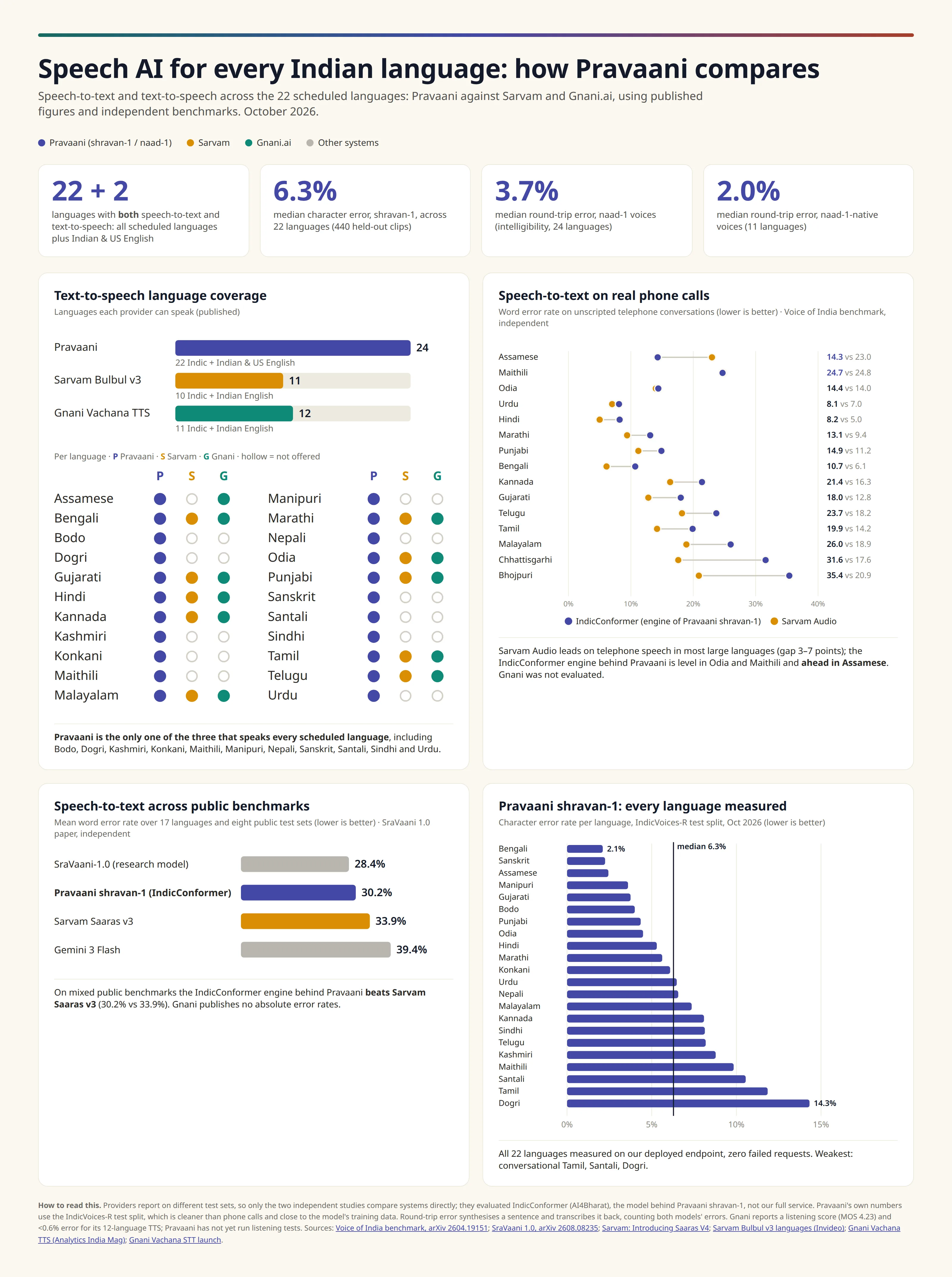
Choosing a speech API for Indian languages starts with two questions: does it speak your customers’ language, and how well? Here is Pravaani Speech against Sarvam and Gnani.ai, from published figures, two independent studies and our own measurements, weak spots included.
- 22 + 2
- languages with both speech-to-text and text-to-speech: every scheduled language, plus Indian and US English
- 6.3%
- median character error rate, shravan-1, across 22 languages (440 held-out clips)
- 3.7%
- median round-trip error, naad-1 voices (intelligibility, 24 languages)
- 2.0%
- median round-trip error, naad-1-native voices (11 languages)
Text-to-speech languages
Pravaani is the only one of the three that speaks every scheduled language. Language by language
Data table
| Provider | Languages | Of which |
|---|---|---|
| Pravaani | 24 | naad-1 and naad-1-native: 22 Indic + Indian and US English |
| Sarvam Bulbul v3 | 11 | 10 Indic + Indian English |
| Gnani Vachana TTS | 12 | 11 Indic + Indian English |
Text-to-speech, language by language
Eleven languages only Pravaani speaks
Bodo, Dogri, Kashmiri, Konkani, Maithili, Manipuri, Nepali, Sanskrit, Santali, Sindhi and Urdu have a Pravaani voice and none from Sarvam Bulbul v3 or Gnani Vachana TTS. All three speak Bengali, Gujarati, Hindi, Kannada, Malayalam, Marathi, Odia, Punjabi, Tamil and Telugu; Gnani also speaks Assamese.
Where our voices are weaker. Kashmiri, Maithili and Sindhi have no trained speaker yet. Their voices are set by a text description, so short phrases are clear and long sentences degrade (round-trip error 47.0%, 20.9% and 12.7%). Native reference voices are the next step.
Who speaks which scheduled language
- P Pravaani
- S Sarvam Bulbul v3
- G Gnani Vachana TTS
- not offered
- only Pravaani
| Language | P | S | G |
|---|---|---|---|
| Assamese | Yes | No | Yes |
| Bengali | Yes | Yes | Yes |
| Bodo (only Pravaani) | Yes | No | No |
| Dogri (only Pravaani) | Yes | No | No |
| Gujarati | Yes | Yes | Yes |
| Hindi | Yes | Yes | Yes |
| Kannada | Yes | Yes | Yes |
| Kashmiri (only Pravaani) | Yes | No | No |
| Konkani (only Pravaani) | Yes | No | No |
| Maithili (only Pravaani) | Yes | No | No |
| Malayalam | Yes | Yes | Yes |
| Language | P | S | G |
|---|---|---|---|
| Manipuri (only Pravaani) | Yes | No | No |
| Marathi | Yes | Yes | Yes |
| Nepali (only Pravaani) | Yes | No | No |
| Odia | Yes | Yes | Yes |
| Punjabi | Yes | Yes | Yes |
| Sanskrit (only Pravaani) | Yes | No | No |
| Santali (only Pravaani) | Yes | No | No |
| Sindhi (only Pravaani) | Yes | No | No |
| Tamil | Yes | Yes | Yes |
| Telugu | Yes | Yes | Yes |
| Urdu (only Pravaani) | Yes | No | No |
Published language lists, October 202645. Each provider may add languages after this date.
Speech-to-text accuracy
Ahead on public benchmarks, catching up on phone calls
Two independent studies evaluated IndicConformer, the AI4Bharat model behind shravan-1. Across eight public test sets it beats Sarvam Saaras v3. On real telephone conversations, Sarvam Audio leads in most large languages.
Where we are improving. Phone audio (8 kHz, noisy, often code-mixed) is harder than the recordings shravan-1 is measured on. We are tuning it on real call audio; a pilot should re-measure on its own calls.
Mean word error rate, 17 languages, eight public test sets
Lower is better. SraVaani 1.0 paper, independent2
On mixed public benchmarks the IndicConformer model behind Pravaani beats Sarvam Saaras v3 (30.2% against 33.9%). A research model, SraVaani-1.0, is ahead of both. Gnani publishes no absolute error rates6.
Data table
| System | Mean WER % |
|---|---|
| SraVaani-1.0 (research model) | 28.4 |
| Pravaani shravan-1 (IndicConformer) | 30.2 |
| Sarvam Saaras v3 | 33.9 |
| Gemini 3 Flash | 39.4 |
Word error rate on unscripted phone calls
Lower is better. Voice of India benchmark, independent1
- IndicConformer (the model behind shravan-1)
- Sarvam Audio
- AssameseIndicConformer 14.3%, Sarvam Audio vs 23.0%
- MaithiliIndicConformer 24.7%, Sarvam Audio vs 24.8%
- OdiaIndicConformer 14.4%, Sarvam Audio vs 14.0%
- UrduIndicConformer 8.1%, Sarvam Audio vs 7.0%
- HindiIndicConformer 8.2%, Sarvam Audio vs 5.0%
- MarathiIndicConformer 13.1%, Sarvam Audio vs 9.4%
- PunjabiIndicConformer 14.9%, Sarvam Audio vs 11.2%
- BengaliIndicConformer 10.7%, Sarvam Audio vs 6.1%
- KannadaIndicConformer 21.4%, Sarvam Audio vs 16.3%
- GujaratiIndicConformer 18.0%, Sarvam Audio vs 12.8%
- TeluguIndicConformer 23.7%, Sarvam Audio vs 18.2%
- TamilIndicConformer 19.9%, Sarvam Audio vs 14.2%
- MalayalamIndicConformer 26.0%, Sarvam Audio vs 18.9%
- ChhattisgarhiIndicConformer 31.6%, Sarvam Audio vs 17.6%
- BhojpuriIndicConformer 35.4%, Sarvam Audio vs 20.9%
Sarvam Audio leads on telephone speech in most large languages, by 3 to 7 points, and by 14.0 and 14.5 points in Chhattisgarhi and Bhojpuri. IndicConformer is level in Odia and Maithili and ahead in Assamese (14.3% against 23.0%). Gnani was not evaluated.
Data table
| Language | IndicConformer WER % | Sarvam Audio WER % |
|---|---|---|
| Assamese | 14.3 | 23.0 |
| Maithili | 24.7 | 24.8 |
| Odia | 14.4 | 14.0 |
| Urdu | 8.1 | 7.0 |
| Hindi | 8.2 | 5.0 |
| Marathi | 13.1 | 9.4 |
| Punjabi | 14.9 | 11.2 |
| Bengali | 10.7 | 6.1 |
| Kannada | 21.4 | 16.3 |
| Gujarati | 18.0 | 12.8 |
| Telugu | 23.7 | 18.2 |
| Tamil | 19.9 | 14.2 |
| Malayalam | 26.0 | 18.9 |
| Chhattisgarhi | 31.6 | 17.6 |
| Bhojpuri | 35.4 | 20.9 |
Pravaani shravan-1
Every language, measured
Character error rate for all 22 scheduled languages on our deployed endpoint: 20 held-out clips each from the IndicVoices-R test split, 2 October 2026. Median 6.3%, zero failed requests.
Weakest today: conversational Tamil (11.8%), Santali (10.5%) and Dogri (14.3%). In Malayalam and Tamil, long agglutinated words turn one wrong letter into one wrong word, so character error is the fairer measure there; the data table also lists word error.
shravan-1 character error rate per language
Lower is better. IndicVoices-R test split, October 2026.
Data table
| Language | STT CER % | STT WER % | Clips | naad-1 round-trip CER % | naad-1-native round-trip CER % |
|---|---|---|---|---|---|
| Assamese | 2.4 | 9.0 | 20 | 2.5 | 5.7 |
| Bengali | 2.1 | 11.3 | 20 | 0.5 | 0.0 |
| Bodo | 4.0 | 15.1 | 20 | 4.2 | n/a |
| Dogri | 14.3 | 25.6 | 20 | 2.6 | n/a |
| Gujarati | 3.8 | 10.5 | 20 | 1.2 | 1.2 |
| Hindi | 5.3 | 17.9 | 20 | 3.5 | 6.0 |
| Kannada | 8.1 | 26.7 | 20 | 5.1 | 7.2 |
| Kashmiri | 8.8 | 28.3 | 20 | 47.0 | n/a |
| Konkani | 6.1 | 23.7 | 20 | 9.4 | n/a |
| Maithili | 9.8 | 33.1 | 20 | 20.9 | n/a |
| Malayalam | 7.4 | 39.1 | 20 | 4.3 | 4.8 |
| Manipuri | 3.6 | 15.3 | 20 | 2.0 | n/a |
| Marathi | 5.6 | 17.9 | 20 | 2.0 | 2.0 |
| Nepali | 6.6 | 17.5 | 20 | 6.1 | n/a |
| Odia | 4.5 | 14.0 | 20 | 2.3 | 1.7 |
| Punjabi | 4.3 | 11.7 | 20 | 0.0 | 0.0 |
| Sanskrit | 2.2 | 15.8 | 20 | 6.7 | n/a |
| Santali | 10.5 | 38.3 | 20 | 7.8 | n/a |
| Sindhi | 8.1 | 21.8 | 20 | 12.7 | n/a |
| Tamil | 11.8 | 36.5 | 20 | 4.0 | 2.6 |
| Telugu | 8.2 | 27.8 | 20 | 1.7 | 0.0 |
| Urdu | 6.5 | 10.3 | 20 | 3.1 | n/a |
| English (India) | n/a | n/a | n/a | 17.7 | n/a |
| English (US) | n/a | n/a | n/a | 2.3 | n/a |
Method and caveats
How to read these numbers
- Different test sets. Providers report on different test sets, so only the two independent studies compare systems directly.
- The model, not the service. Those studies evaluated IndicConformer (AI4Bharat), the model behind Pravaani shravan-1, not our full service.
- Clean audio. Our own numbers use the IndicVoices-R test split, which is cleaner than phone calls and close to the model’s training data. Real calls will score worse.
- Round-trip error. A sentence is synthesised, then transcribed back by shravan-1, so the figure counts both models’ errors: an upper bound on how hard the speech is to understand.
- Listening tests. Gnani reports a listening score (MOS 4.23) and under 0.6% error for its 12-language TTS5. Pravaani has not yet run listening tests; intelligibility is not naturalness.
- Small samples. 20 clips per language show where each language stands, not a decimal-point ranking between languages.
Sources
- Voice of India benchmark, arXiv 2604.19151
- SraVaani 1.0, arXiv 2608.08235
- Sarvam: Introducing Saaras V4, September 2026. Saaras V4 came out after both studies, which tested Saaras v3; it has no independent figures yet.
- Sarvam Bulbul v3 languages (Invideo)
- Gnani Vachana TTS (Analytics India Mag)
- Gnani Vachana STT launch
- Pravaani speech quality across the 22 scheduled languages: measured 2 October 2026 on the deployed Pravaani Speech endpoint, 440 held-out IndicVoices-R clips (AI4Bharat, CC-BY-4.0).
Download the comparison: WebP image (0.5 MB) or PNG (1 MB), October 2026.
Sarvam, Saaras, Bulbul, Gnani.ai, Vachana and Gemini are the names of their owners’ products, used here only to identify them. Figures are as published by the sources above, October 2026.
Platform
One voice layer for every product
Agents listens and speaks on calls through Speech. Studio voices and dubs videos through Speech. Your app can call the same service.
Each product uses its own key, so every minute is attributed to the product that used it and charged to one Pravaani credit wallet. Improvements to a language reach every product that uses it.
- Agentslistens and speaks on calls
- Studiovoice-overs and dubs
- Your appone API key
- Speech-to-text
- Streaming
- Text-to-speech
- Consented cloning
- Streaming voices
Trust
Rules the API enforces
Each one is enforced in the code.
No clone without consent
Cloning requests without a verified consent record are refused. They are never quietly served with another voice.
Licences respected in routing
Every model carries its licence. Models licensed for non-commercial use are not served to commercial accounts, and fallback never skips a licence hold.
No silent downgrades
If a model that needs a GPU has none, the request fails with a clear error instead of running far slower on a CPU.
Where it runs
A production deployment in India, with GPUs in RunPod’s AP-IN-1 region, is planned as an option. It is not a data-residency commitment.
FAQ
Hindi, Tamil and Telugu speech APIs: common questions
Want a finished product instead of an API? Agents answers calls and Studio makes videos, both on Speech.
Still wondering?Ask the Pravaani agent itself, in your language. Talk to the agent
Is there a text-to-speech API for Hindi and other Indian languages?
Yes. Pravaani Speech turns text into speech with the voices available for each language (POST /v1/tts, returning WAV, MP3, OGG or FLAC). Voices vary by language and model; GET /v1/voices lists what your deployment serves.
Is there a speech-to-text API for Tamil, Telugu and other Indian languages?
Yes. Upload a recording to POST /v1/stt and get the transcript as JSON, with timestamped segments. Speech-to-text covers all 22 scheduled Indian languages plus English.
Which Indian languages does Pravaani Speech support?
All 22 scheduled languages of India, with both speech-to-text and text-to-speech: Assamese, Bengali, Bodo, Dogri, Gujarati, Hindi, Kannada, Kashmiri, Konkani, Maithili, Malayalam, Manipuri, Marathi, Nepali, Odia, Punjabi, Sanskrit, Santali, Sindhi, Tamil, Telugu and Urdu, plus English (India) and English (US). The per-language results show how each one measures.
How does Pravaani Speech compare with Sarvam and Gnani?
Pravaani is the only one of the three with text-to-speech in every scheduled language: 24 languages with Indian and US English, against 11 for Sarvam Bulbul v3 and 12 for Gnani Vachana TTS, English included in each, as published in October 2026. On eight public test sets, the IndicConformer model behind shravan-1 averages 30.2% word error against 33.9% for Sarvam Saaras v3; on telephone speech, Sarvam Audio leads in most large languages. See the full comparison.
Can I stream live speech-to-text for phone calls?
Yes. Send 16 kHz PCM audio over the WebSocket at /v1/stt/stream and receive partial and final transcripts as the caller speaks. Pravaani Agents uses live streaming on its calls.
Does it work with the OpenAI SDK?
Yes. Point the OpenAI SDK’s base_url at https://<your-speech-host>/openai/v1 and use your Pravaani key as the api_key: audio.speech.create (MP3, WAV, FLAC or PCM) and audio.transcriptions.create (JSON, text, SRT, VTT or verbose JSON with segments) work, with the models naad-1 and shravan-1; OpenAI’s model and voice names are mapped to them. Name the language, since there is no auto-detect. Translation, Opus and AAC output and word timestamps are not supported. The native REST and WebSocket API (POST /v1/stt, POST /v1/tts, WS /v1/stt/stream) is there too.
Can I clone a voice through the API?
Only with an unrevoked consent record from the voice’s owner that covers cloning, and only where cloning is enabled for the deployment. Otherwise the request is refused.
Make your first request.
Read the docs, then try a transcription or a voice in the Speech console.